
Cast Away
A Humbling Lesson in Letting Go


“Humble yourselves, therefore, under the mighty hand of God so that at the proper time he may exalt you, casting all your anxieties on him, because he cares for you.” — 1 Peter 5:6–7
Peter made his living casting nets on the Sea of Galilee.
When he tells us to “cast our anxieties,” it’s tempting to hear it as the hook of a fisherman-turned-preacher.
But that’s not what Peter means.
The word he uses in this passage is not the same one that would describe casting nets for a haul of redbelly tilapia.
Instead, Peter uses a unique Greek word that means to throw, or to hurl.
This is not cast and reel back in.
This is cast—and let go.
The common Greek word for casting in Scripture is ballō. It appears hundreds of times, including when fishermen like Peter cast their nets (ex. Matt. 4:18).
Instead, Peter uses the word epiripto, which paints a much different picture.
It is a proactive call to action to fully transfer the weight and burdens of our cares onto God. One commentator describes it as “a vital spiritual rhythm of shifting weight from self to Savior.”
To do that, we have to first humble ourselves, which is really the point Peter is making.
Humility is an antidote to anxiety. We have to choose to humble ourselves to God.
It is the blade that slices through the line we are so often tempted to reel back in with our worries still on the hook.
That’s why Peter precedes the imperative to cast our cares with this command:
“Humble yourselves, therefore, under the mighty hand of God…” — 1 Peter 5:6 (cf. Prov. 3:34).
This verse is vitally connected to verse seven and the command to cast our cares. Verses 6–7 are actually one sentence in the original Greek, and the word casting ends in “-ing” because it is a participle that depends on the command to humble ourselves. An issue with the NIV translation is that it separates verses six and seven into two sentences.
You have to see the connection between humility and casting. Otherwise, you will be tangled in the net of your own anxiety.
Our worries are a form of pride.
Pride causes us to hold on.
Casting is only the act of throwing.
Humility is when we release our grip.
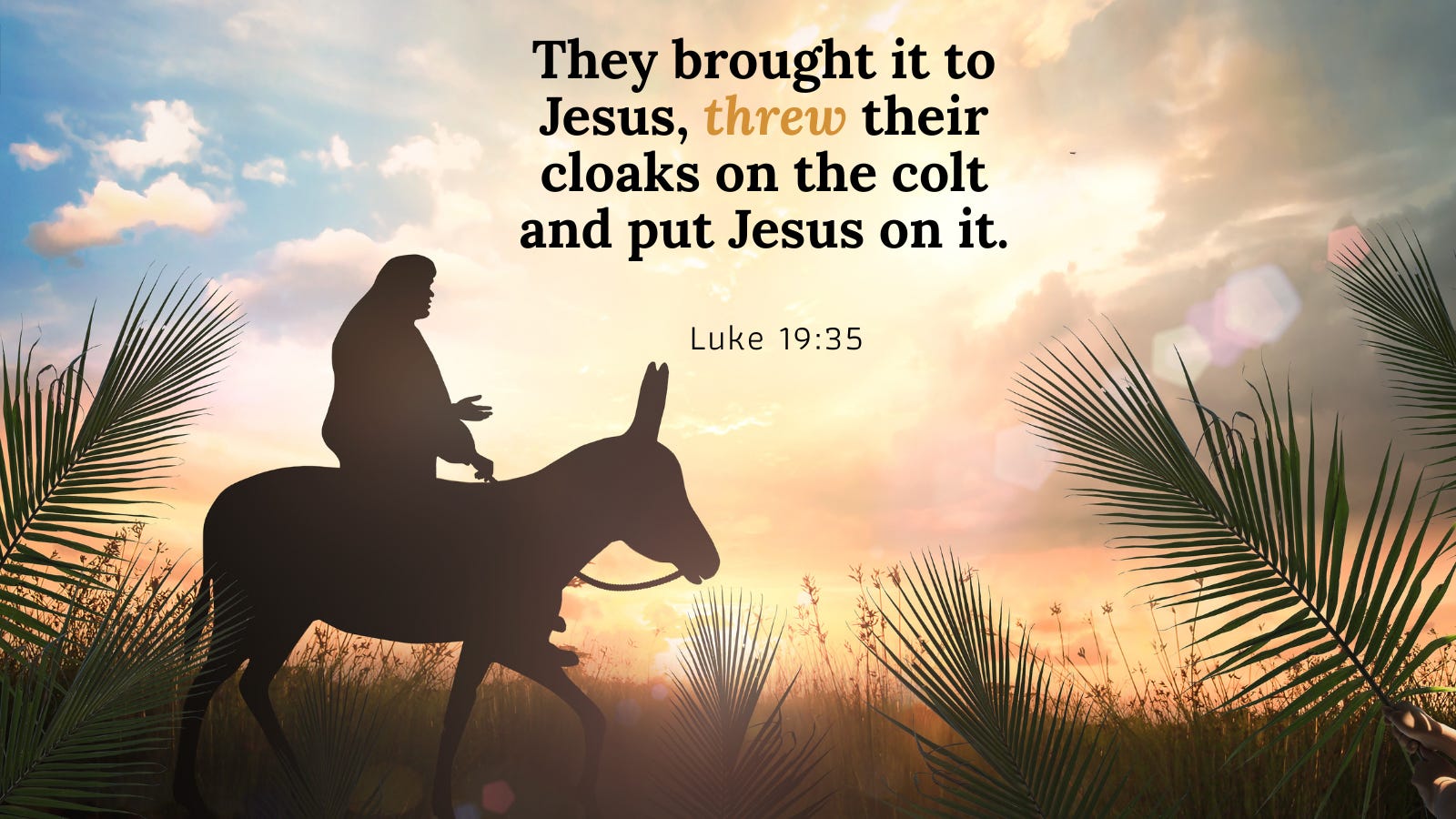
Another clue that the epiripto word choice is important is that it appears only one other time in the New Testament—Luke 19:35—when the disciples throw their cloaks onto a colt for Jesus to ride into Jerusalem on Palm Sunday.
That moment becomes a physical act of humbly casting that illustrates the spiritual act Peter describes.
Palm Sunday is a beautiful picture of humility.
Jesus humbles Himself by riding into Jerusalem on a lowly animal, fulfilling the prophecy of Zechariah 9:9. He could have entered the city on a warhorse. That’s what the people assumed the Messiah brought — deliverance from Rome. That’s why they waved palm branches — a national symbol of Israel.
But Jesus did not just come to save one group from one oppressor. He came to save ALL PEOPLE from the ultimate oppression of sin. That is what Easter is all about — Jesus humbly taking our place on the cross and defeating death at His resurrection.
Another moment of humility came on Palm Sunday when the disciples literally gave the shirts off their backs, throwing their cloaks onto the colt to create a makeshift saddle for their Savior.
This stands in vivid contrast to another part of Peter’s passage where he advises us to “clothe” ourselves in humility (1 Peter 5:5).
Here, Peter uses another rare word that describes a servant tying on an apron. One lexicon explains that the picture is not merely putting on clothing but preparing for humble, hands-on service—the kind considered lowly in the Greco-Roman world.
It mirrors the posture of Jesus in John 13, when He wrapped a towel around His waist and washed the disciples’ feet in one of his final acts before his crucifixion.
Peter initially resisted having his feet washed, but he eventually humbled himself.
A few hours later, Peter denied Jesus three times as he went to the cross — something that Peter swore he would never do.
But Jesus did not cast him out.
He actually reeled him back in.
After His resurrection, Jesus called Peter back in from casting his fishing nets and restored him. (John 21:15-19)
Jesus offers the same restoration to anyone willing to cast their sins at the cross.
Easter is dawning. It’s easy to lose the momentum gained during Lent. Or maybe you don’t regularly attend church and are wrestling with going back next week after the emotional high of the day.
Keep casting.
Peter shows us we may have to humble ourselves many times to loosen our grip.
But it was possible for this fisherman from Galilee, and it’s possible for you.
Cut the line.
Cast and let go.
Mountain Mover
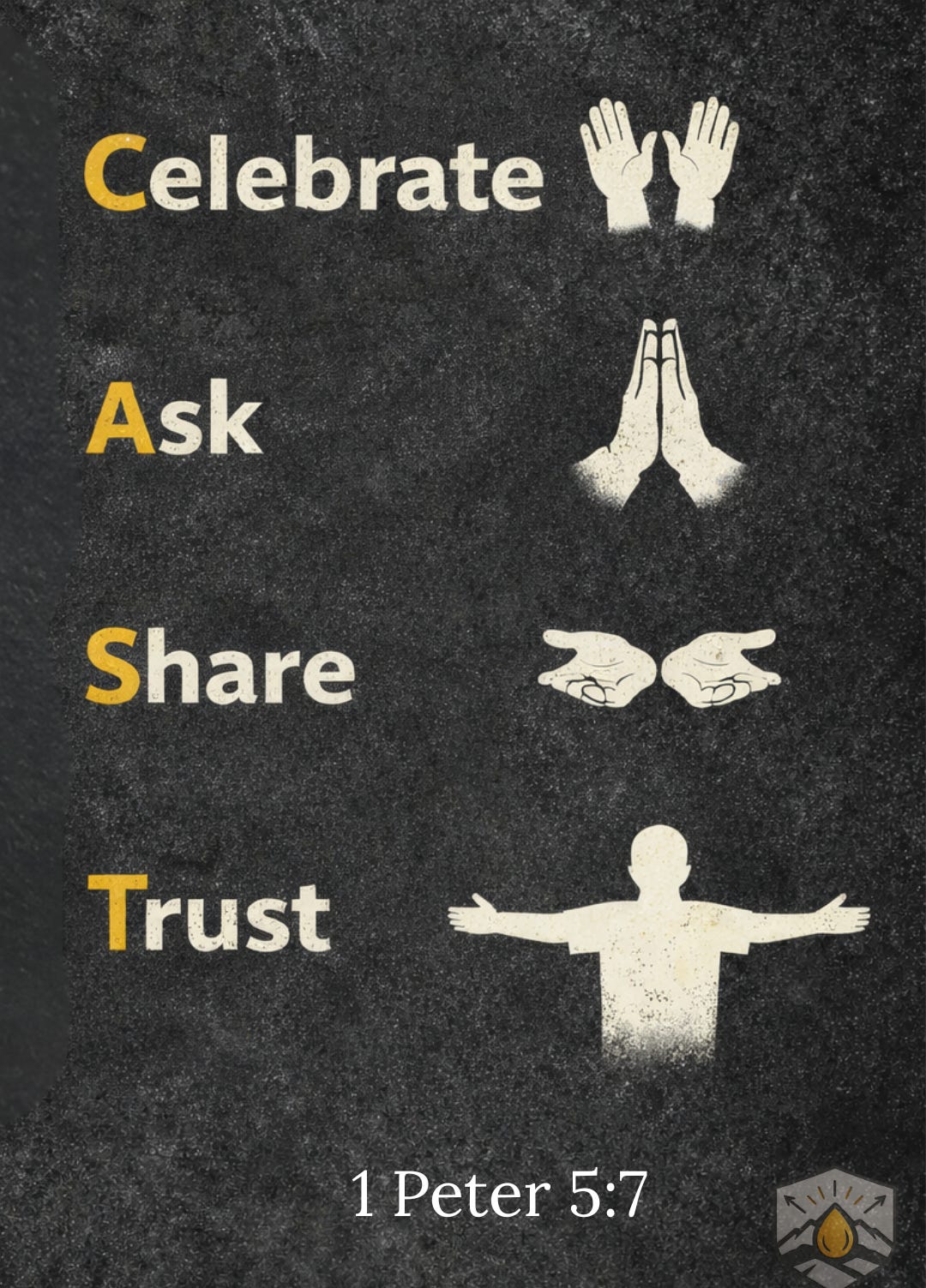
Here’s a simple way to practice cast and release:
C — Celebrate (Hands up)
It’s hard to be anxious and grateful at the same time. Celebration loosens anxiety’s grip.
A — Ask (Hands together in prayer)
The boldness of your prayers will be driven by the boldness of your faith. Do you believe in a powerful God who loves you? Then pray boldly. He tells us to ask, seek, and knock (Matthew 7:7). Timidity in prayer is a trust issue and a sign that you are not fully casting your cares to God.
S — Share (Hands out in front)
“Confess your sins to one another and pray for one another, that you may be healed” (James 5:16). Anxiety grows in isolation. Healing grows in community.
T — Trust (Hands in the shape of a cross)
Trust that God loved you enough to send His Son so that whoever believes in Him will not perish but have everlasting life (John 3:16). If you use this to teach others, insert the Gospel here. The first casting lesson is casting our sins to the cross.
—
Operation Mustard Seed
New article every week
—
The Suffer Up Podcast releases a new episode each Monday on all platforms.