
Zoom Out
See the bigger picture of John's signs

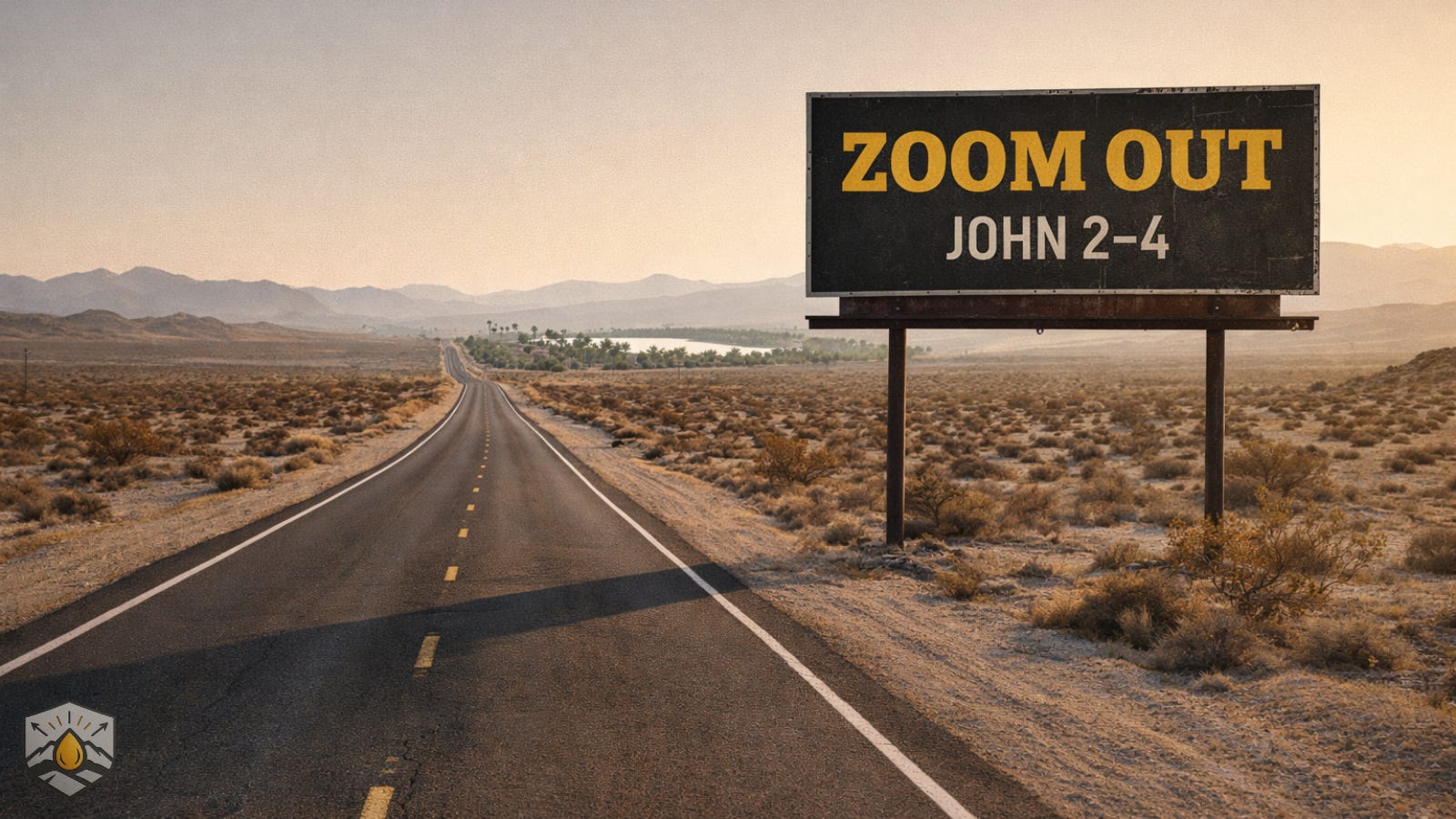
This is Week 1 of a series inviting you to zoom out to see the bigger picture of Scripture.
“Now there are also many other things that Jesus did. Were every one of them to be written, I suppose that the world itself could not contain the books that would be written.” — John 21:25
John knew he could not possibly document everything Jesus did.
So he made intentional choices.
Rather than recording every miracle, John curated specific moments that best reveal the life and ministry of Jesus. He refers to these miracles as signs—a term uniquely emphasized in the Gospel of John.
What is the purpose of a sign?
Signs always point to something greater.
An exit sign points to a way out.
A trail blaze guide you up a mountain.
A road sign points to the way ahead.
John plants seven signs throughout his Gospel.
And he is very clear about what they point to:
“These are written so that you may believe that Jesus is the Christ, the Son of God, and that by believing you may have life in his name.” — John 20:31
Jesus’ first sign happens in Cana: turning water into wine (John 2).
His second sign occurs in the same town: healing a royal official’s son (John 4).
Two signs.
One location.
This is a deliberate bookend.
Zoom out—and it becomes a billboard pointing straight to the Gospel.
The First Sign: A Wedding and New Wine (John 2)
John 2 opens with a wedding steeped in Jewish tradition and imagery. The wine runs out at the wedding—a significant social faux pas in a first-century setting. Jesus’s mother asks him for help. He initially seems hesitant, saying, “My hour has not yet come” (John 2:4).
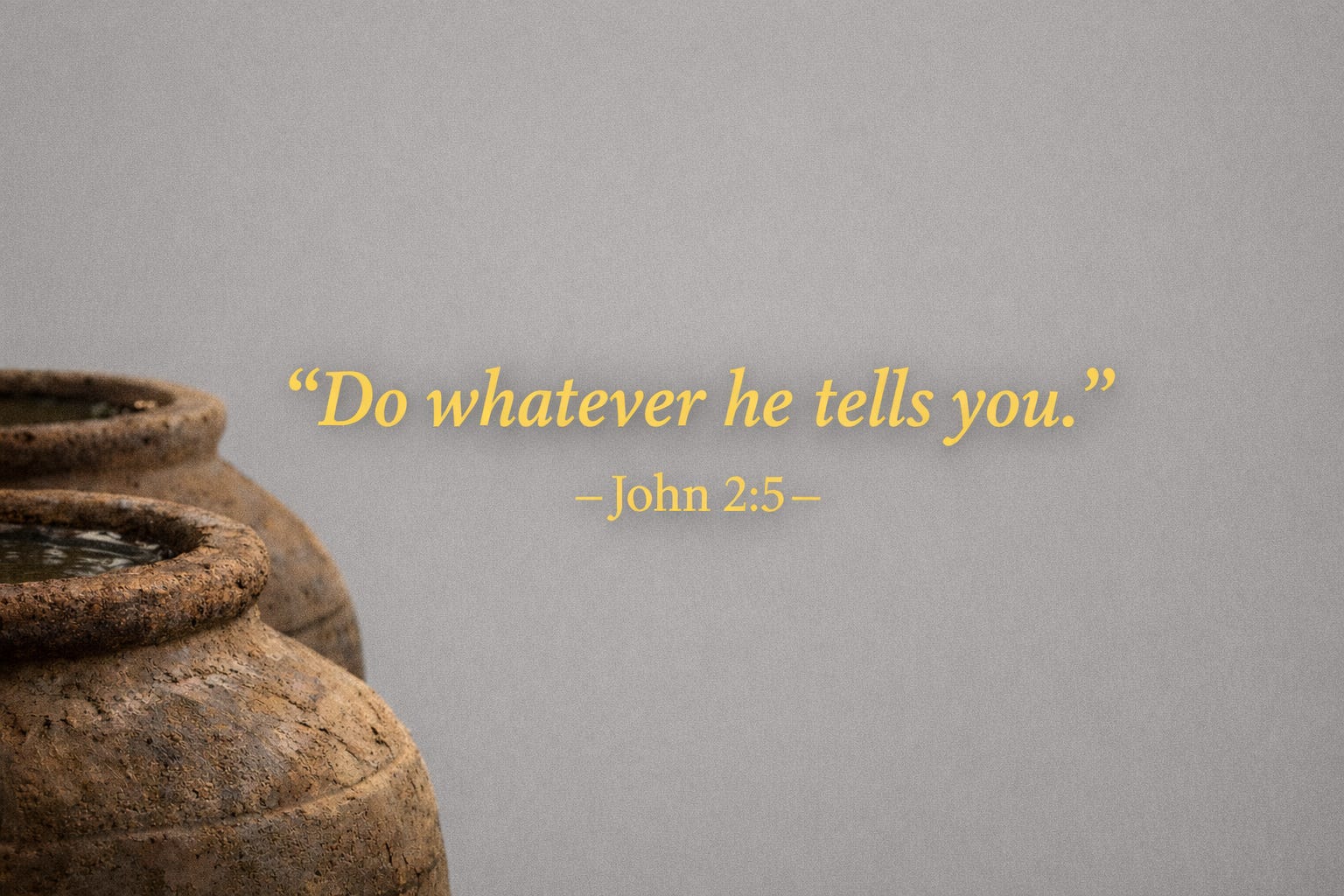
Mary then gives the wedding servants some of the best advice in all of Scripture:
“Do whatever he tells you” (John 2:5).
Jesus takes water from purification jars and transforms it into wine so good it shocks the master of ceremonies. It was customary for the good wine to be served first—not last. This is an important detail.
Jesus did not transform water into wine merely to help his mother. He did not do this to give us a reason to debate social drinking.
This was a sign—pointing to His power to transform.
If He can take water meant for ceremonial washing and turn it into celebratory wine, He can transform us too.
Jesus is revealing that the old covenant system of outward cleansing is giving way to a new covenant of inward transformation.
This moment also foreshadows the ultimate wedding feast of Revelation 19, where Jesus is united with His bride, the Church:
“Blessed are those who are invited to the marriage supper of the Lamb.”
— Revelation 19:9
Good news—we are all invited.
And Jesus is saving the best for last.
So how do we prepare to join that marriage feast?
Follow the signs John places next.
Between the Signs: Four Snapshots
John 2:13–25 — Jesus Cleanses the Temple
Jesus drives out the money changers and declares that the temple will be destroyed and raised in three days. He is pointing toward His crucifixion and resurrection.
That sign—the greatest miracle of all—reveals that the dwelling place of God is no longer a building.
It is Him.
John 3:1–21 — Nicodemus at Night
Nicodemus, a Pharisee and respected teacher of Scripture, comes to Jesus under the cover of darkness. A humble Jewish carpenter teaches one of the most educated men of his era.
Jesus explains that salvation requires new birth, not religious performance.
The physical birth we have all experienced leads to death.
Those who receive new spiritual birth through faith receive eternal life (John 3:16).
John 3:22–36 — The Best Man Speaks
John the Baptist reappears after first testifying that Jesus is the Lamb of God in John 1. Here, he refers to himself as the friend of the bridegroom—the best man at the wedding.
This draws the narrative thread tighter between the wedding at Cana and the final wedding feast in Revelation 19.
John 4:1–43 — Living Water for an Outcast
Jesus meets a Samaritan woman at a well in the heat of the day—a purposefully sharp contrast to Nicodemus’ nighttime visit. She is rejected by Jews and by her own people. Her life is marked by broken relationships.
Still, Jesus meets her exactly where she is and offers her living water.
She becomes a bold witness to her entire town.
And many believed. (John 4:39-43)
The Second Sign: Faith Without Sight (John 4)
John brings us back to Cana—the same place of the wedding and the new wine. He wants us to see the connection.
A Roman official travels nearly 20 miles to meet Jesus because his son is dying. At first, Jesus seems to resist because many people were chasing signs instead of truth.
But this man persists—not as a powerful official, but as a desperate father.
Jesus simply says, “Your son will live.” (John 4:50)
And the man walks away.
No proof.
No spectacle.
Just faith.
Later, he discovers his son was healed at the exact moment Jesus spoke the word.
“So he and his whole household believed.” — John 4:53
Read the Signs Backward
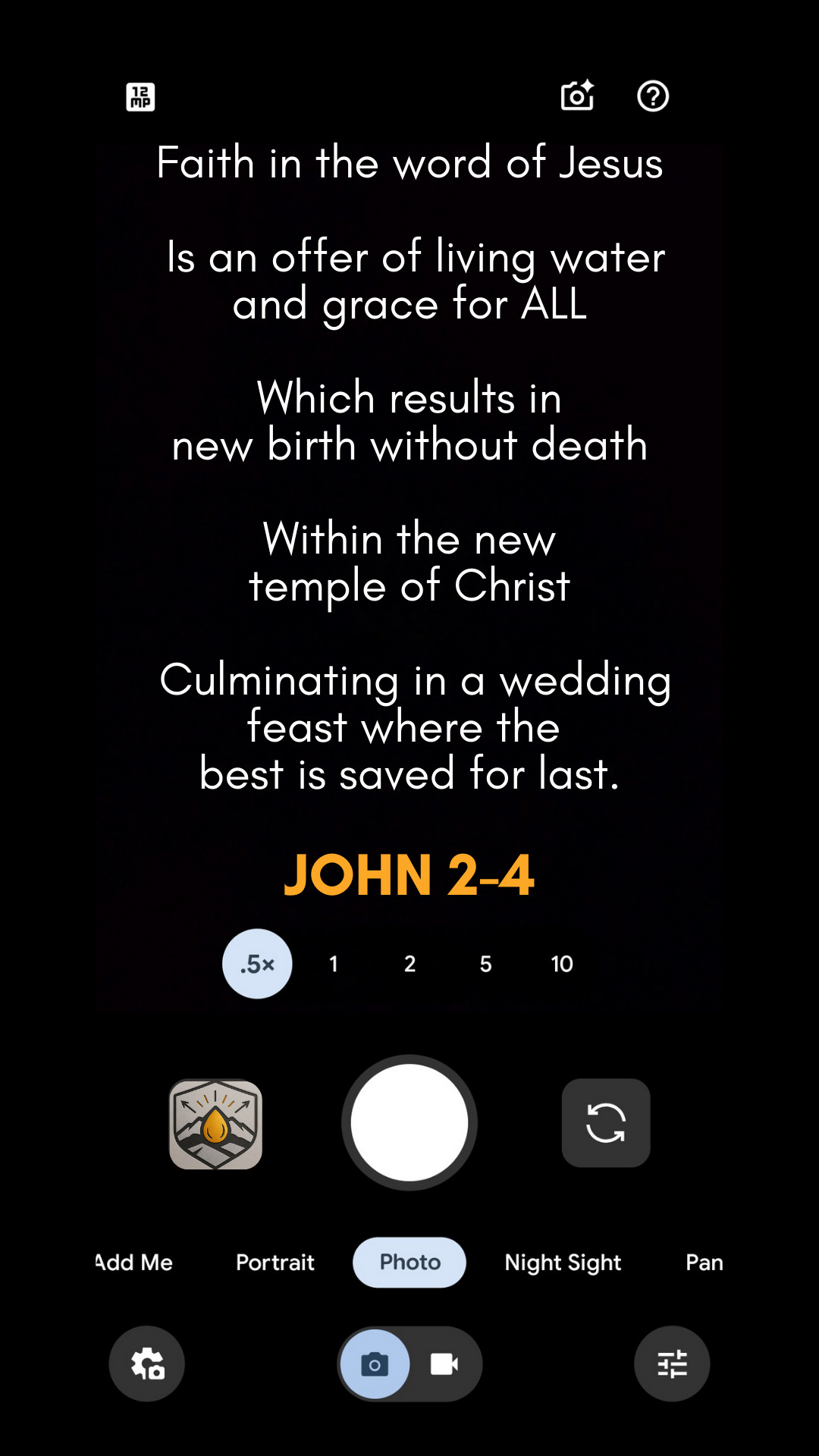
Now zoom out and read John 2–4 in reverse:
→ Faith in the word of Jesus
→ leads to living water and grace for all
→ which results in new birth without death
→ within the new temple of Christ
→ culminating in a wedding feast where the best is saved for last
Do you see where these signs point now?
It’s worth repeating this verse:
“These are written so that you may believe that Jesus is the Christ, the Son of God, and that by believing you may have life in his name.” — John 20:31
Mountain Mover
These are the seven signs in John’s Gospel:
Water into Wine — John 2:1–11
Healing the Royal Official’s Son — John 4:46–54
Healing the Paralytic at Bethesda — John 5:1–15
Feeding the Five Thousand — John 6:1–14
Walking on Water — John 6:16–21
Healing the Blind Man at Siloam — John 9:1–41
Raising Lazarus from the Dead — John 11:1–44
Read one per day this week.
Keep a journal of where the signs lead you.
Substack notes will posted throughout the week on Operation Mustard Seed to discuss the signs in John’s gospel.
Resource for Families:
The One O’Clock Miracle (Tales That Tell the Truth) beautifully retells the second sign for young children. It’s a great family read and works well for ages 3–6.
Operation Mustard Seed
New article every Tuesday
Follow the Suffer Up Podcast: New Episodes Each Monday on All Platforms