
The Enemy Tacklebox
Three temptations that hook us all


It’s not hard to carry a tacklebox to the lake worth a small brick from Fort Knox.
Walk into Bass Pro and you can get lost in endless aisles of colorful hula poppers, jigs, and spinners.
Then you get to the lake, and some guy steps onto the bank and lands a monster with a $5 cup of nightcrawlers.
Sometimes the old ways still work best.
That’s true in fishing.
It’s also true in how we are lured.
The Bible warns that we face an enemy that baits us into sin.
And his tacklebox is stocked with the same three lures he’s used from the very beginning.
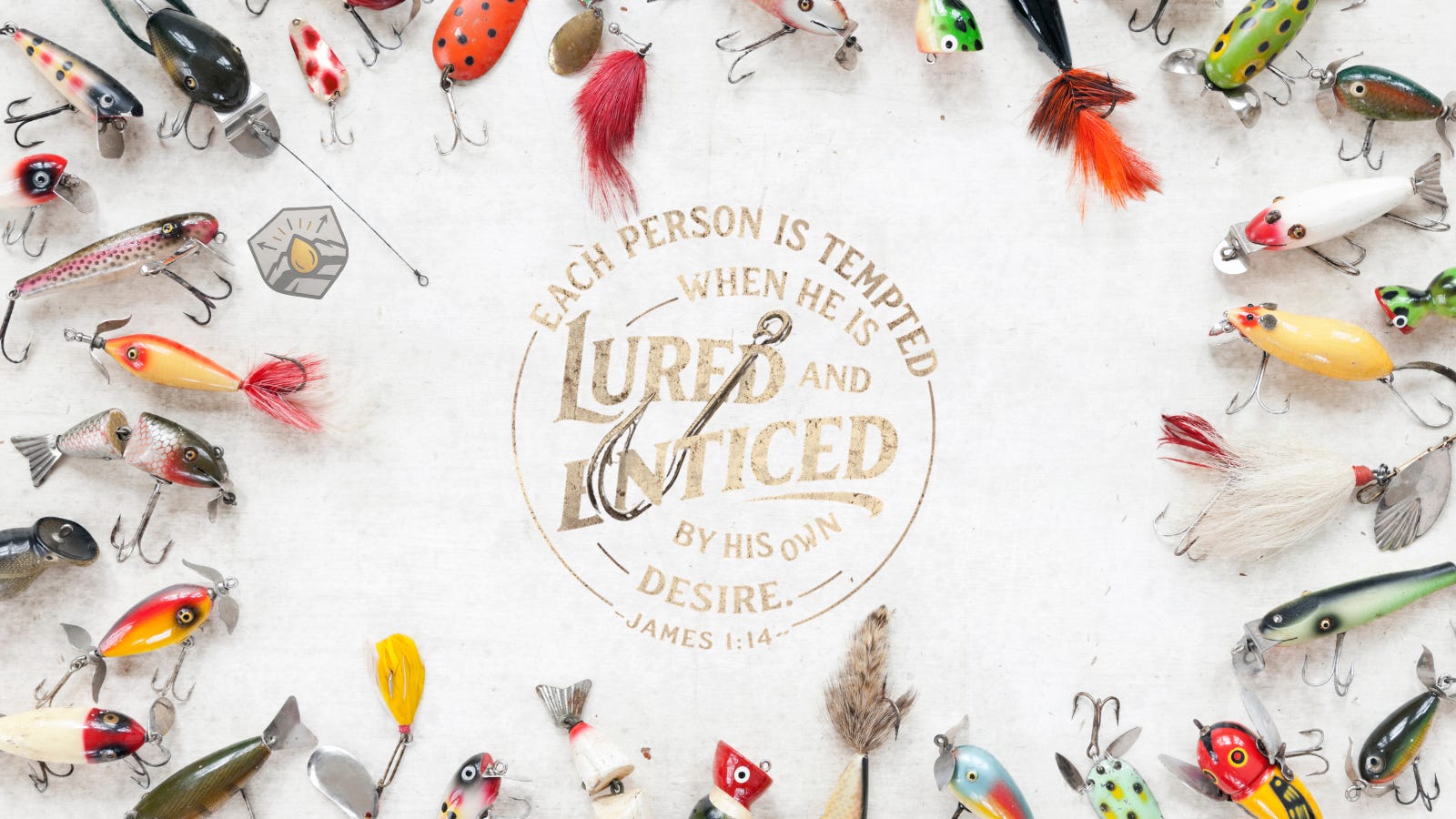
Every Lure Has a Hook
“But each person is tempted when he is lured and enticed by his own desire.”
— James 1:14
Some Bible translations say “carried away” or “dragged away” instead of lured. But the fishing analogy still applies.
To avoid getting hooked, you have to know the bait.
To fight that battle, we must recognize the most common lures in the enemy’s tacklebox. We find that in 1 John 2:16:
For everything in the world—the lust of the flesh, the lust of the eyes, and the pride of life—comes not from the Father but from the world.
Here we see the three most common lures:
Lust of the flesh
Lust of the eyes
Pride of life
What do these mean?
Dr. Thomas Constable of Dallas Theological Seminary summarizes them this way:
Lust of the flesh — the desire to do something apart from the will of God
Lust of the eyes — the desire to have something apart from the will of God
Pride of life — the desire to be something apart from the will of God
Examples:
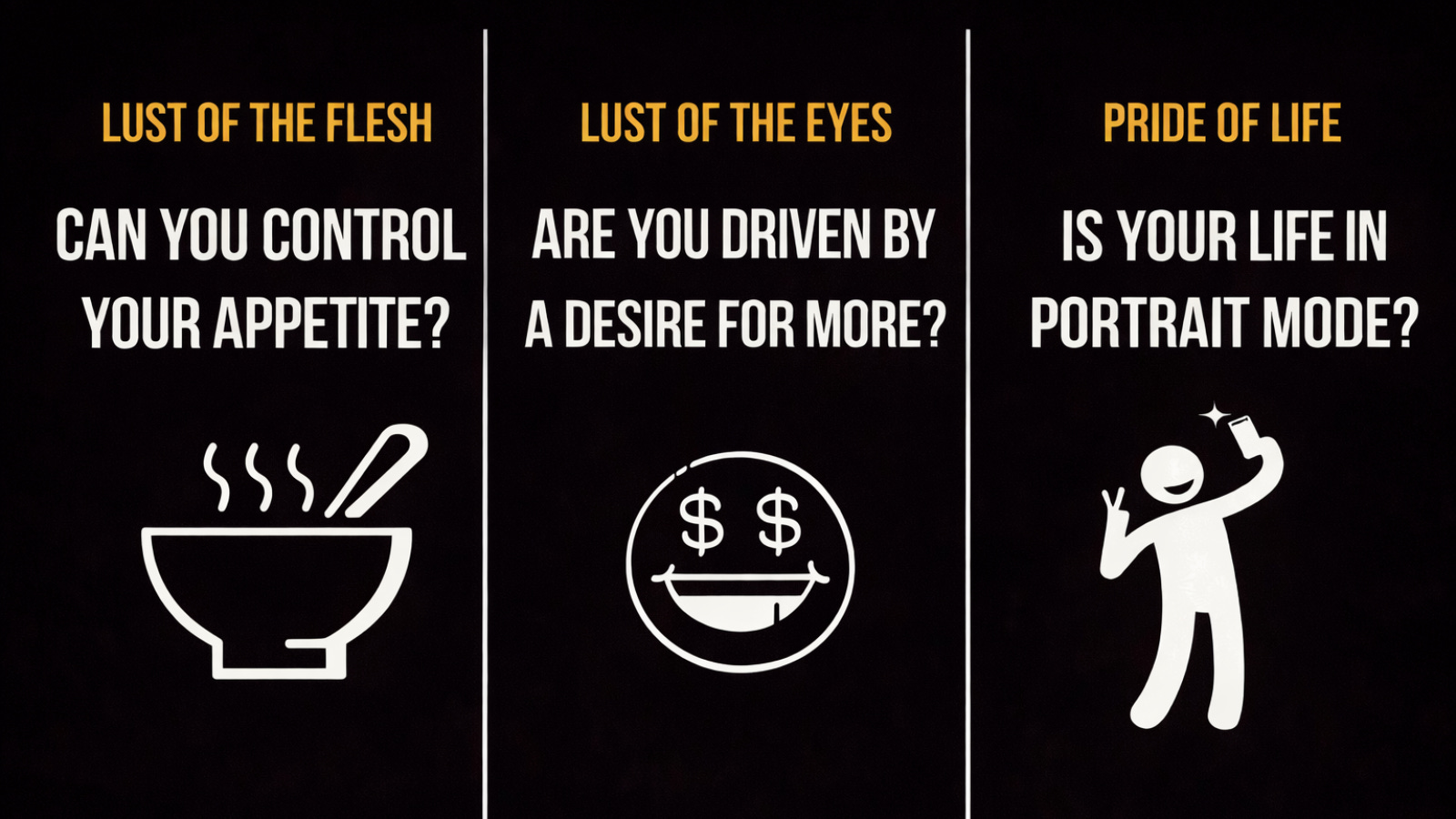
Lust of the flesh
Sexual sin, but it can be any uncontrolled desire. Esau sold his birthright for a bowl of stew (Genesis 25). The question here is: Can you control your appetite?Lust of the eyes
Stuff. More stuff. And even more stuff. There’s nothing wrong with driving a new car — unless the desire for more is what’s driving you. This temptation is marked by covetousness and greed.Pride of life
C.S. Lewis called pride “spiritual cancer.” Ego. Power. Control. If the picture of your life is in perpetual portrait mode — where you are the only thing in focus and everything else is blurry — that’s pride.
The First Bite
These three temptations have been around since the very beginning.
“When the woman saw that the fruit of the tree was good for food and pleasing to the eye, and also desirable for gaining wisdom, she took some and ate it.” — Genesis 3:6
Break it down:
Good for food — Lust of the flesh
Pleasing to the eye — Lust of the eyes
Desirable for gaining wisdom — Pride of life
Now fast forward to Luke 4.
Jesus fasts 40 days and is tempted in the wilderness.
This shows temptation is not the sin. It is what lures us into sin.
Jesus faced the same enemy and the same lures.
The devil’s tactic in Luke 4:
“Turn this stone to bread” — Lust of the flesh (4:3)
Jesus’s physical hunger is under attack after a 40-day fast
“All these kingdoms I will give you” — Lust of the eyes (4:5–7)
Satan offers power, splendor and dominion
“If you are the Son of God, Throw yourself down” — Pride of life (4:9)
Satan attacks Jesus’s identity and tries to misrepresent God’s words, attempting to lure him to commit a prideful act to prove Himself. God had just said that Jesus was his beloved Son and that he was well pleased at His baptism (Luke 3:22). This is the same tactic against Eve — “Did God actually say …” (Genesis 3:1). Satan still attacks the same things today — our identity and God’s word.
There is a powerful contrast in these two temptation narratives.
Adam and Eve failed in a lush garden with everything they needed.
Jesus stood firm after forty days in a barren wilderness after being tempted in every way (Hebrews 4:15). His counterpunch was scripture — “It is written.” (4:4, 8, 10).
Luke frames his Gospel intentionally to draw out these contrasts.
Jesus’s baptism (Luke 3:1-22)
Jesus’s genealogy (traced to Adam) (Luke 3:23-38)
Jesus’s temptation (Luke 4:1-13)
This shows that Jesus is the greater Adam.
We are Adam.
We must never be lured into thinking we can fight temptation on our own strength.
The Season Of Lent
Many faith traditions begin Lent tomorrow on Ash Wednesday.
Lent is a 40-day (excluding Sundays) liturgical season of fasting, prayer, and almsgiving, leading to Holy Week/Good Friday. It centers on Jesus's 40 days of fasting in the desert and temptations, serving as a period of repentance, spiritual renewal, and preparation for Easter.
Mountain Mover
Lent is often a time for people to zoom in on their faith.
But sometimes the best way to see clearly is to zoom out.
Step back.
See the bigger picture.
Put your spiritual lens on 0.5x zoom.
Read an entire Gospel before Easter. Or read Hebrews and embrace its Christological weight.
To help you Zoom Out, Operation Mustard Seed will begin a series next week leading up to Easter.
These articles will connect New Testament passages to Old Testament truths—like hyperlinks that build the metanarrative of Scripture.
They will also explore how the Gospel writers often tell larger truths across multiple episodes.
We’ll close in Hebrews with to show how the epistle frames the race of faith.
February 24 — John: Reading the Signs
March 3 — Table of Mercy: Jesus points to the prophet Hosea
March 10 — Seeing Clearly with Mark
March 17 — Luke 10: The Work Roles of a Christian
March 24 — Snakebit: Jesus points to the serpent in the wilderness
March 31 — Hebrews: Finish Spent.
—
Operation Mustard Seed
New article every Tuesday
—