
We are all snakebit
Look up to the cross for the cure


This is Week 5 of a series inviting you to zoom out to see the bigger picture of Scripture.
When does Jesus first appear in the Bible?
Not Matthew 1:1.
Not the manger.
Page one.
John opens his Gospel with the words, “In the beginning,” which establishes Christ as co-equal with God, eternally existing within the Trinity — one God in three persons.
This truth should shape how we read the Bible — especially the Old Testament.
Jesus is on every page of the Bible — from Genesis to maps.
Just as the miracles in John’s Gospel are called signs because they point to a deeper truth, the Old Testament points forward to Jesus.
Jesus affirms this Himself over and over (John 5:39; Luke 24:27).
One striking example occurs during His nighttime meeting with the Pharisee Nicodemus in John 3.
Nicodemus was the foremost scriptural scholar of his day. He comes intrigued by the signs Jesus is performing, sensing that something extraordinary is unfolding.
After explaining the necessity of new birth, Jesus illuminates the path to eternal life using a passage Nicodemus would have known well:
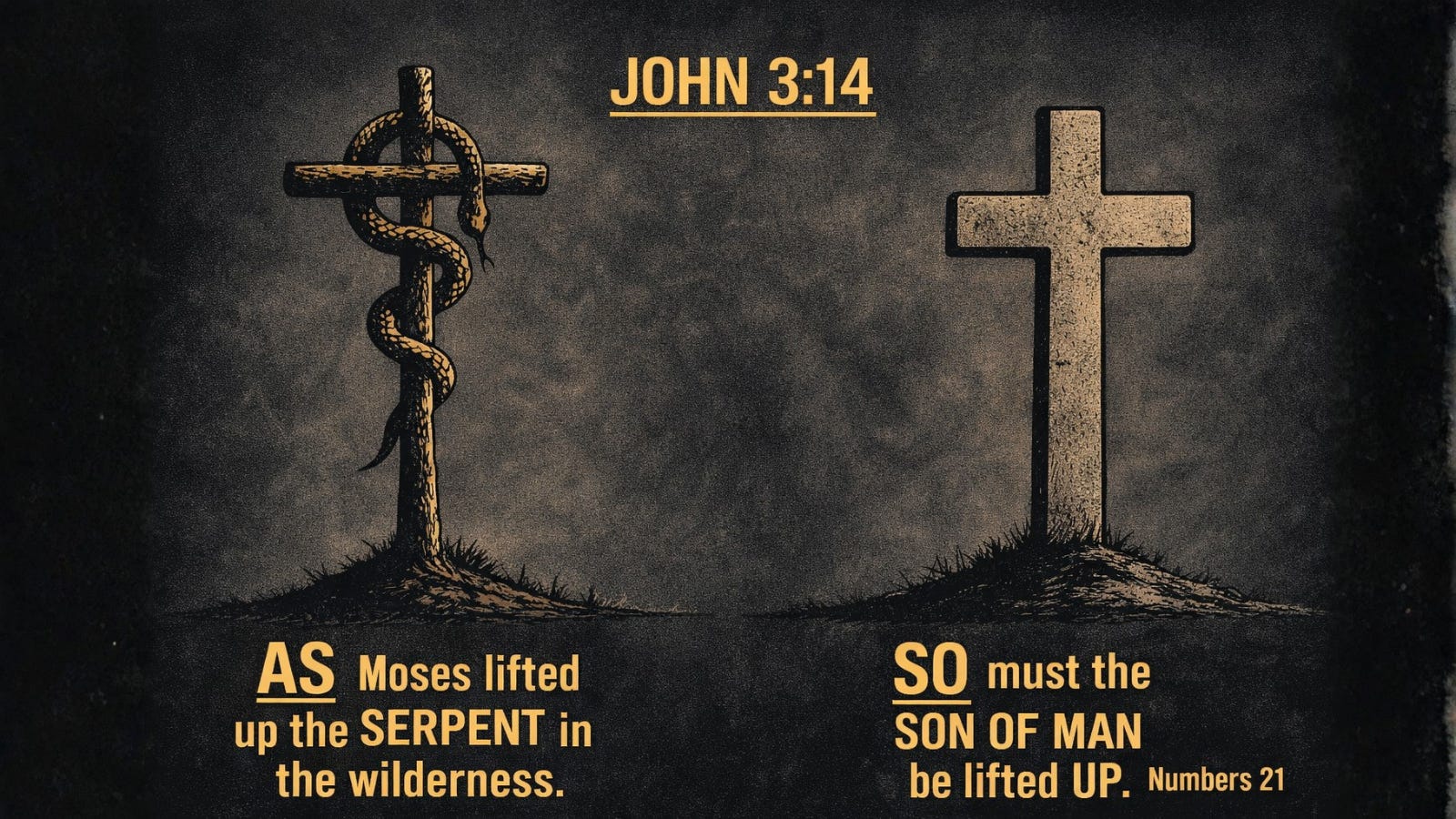
“And as Moses lifted up the serpent in the wilderness, so must the Son of Man be lifted up, that whoever believes in him may have eternal life.” — John 3:14–15
The Serpentine Path
“The serpent in the wilderness” refers to Numbers 21:4–9 — a period of disobedience for the nation of Israel. Judgment followed in the form of fiery, poisonous serpents invading their camp with deathly bites.
The people repent.
Moses intercedes in prayer.
God responds with grace.
Moses is instructed to craft a bronze serpent and raise it on a pole. Anyone who had been bitten could live by simply looking at this symbol of God’s provision.
In that wilderness moment, God’s promise was represented by a bronze serpent. The eternal antidote, however, would come through belief in Jesus — His incarnation, His death, and His resurrection.

We are all snakebit
The serpent became the symbol of sin in Genesis 3, when the devil slithered into the garden. The poison of that first bite still courses through humanity’s veins.
Paul explains it this way:
“…death reigned from Adam to Moses, even over those whose sinning was not like the transgression of Adam…” — Romans 5:14
Paul then says Adam “was a type of the one to come.”
This is biblical typology—the way the Old Testament points forward to Jesus.
Adam points to Jesus.
Where there was death in Adam, there is life in Jesus.
Jesus is the greater Adam, promised in Genesis 3:15 — the protoevangelium, the first gospel proclamation:
“I will put enmity between you and the woman, and between your offspring and her offspring; he shall bruise your head, and you shall bruise his heel.”
Jesus would take the snakebite for us — bruised at the cross — but victory would come through crushing the serpent’s head at His resurrection.
Martin Luther once said this verse “embraces and comprehends within itself everything noble and glorious that is to be found anywhere in the Scriptures.”

Jesus Offers an Antidote
The bronze serpent makes one thing unmistakably clear — salvation comes by grace through faith — not works.
There was nothing the Israelites could do to heal themselves.
Faith alone neutralized the venom.
The same is true today.
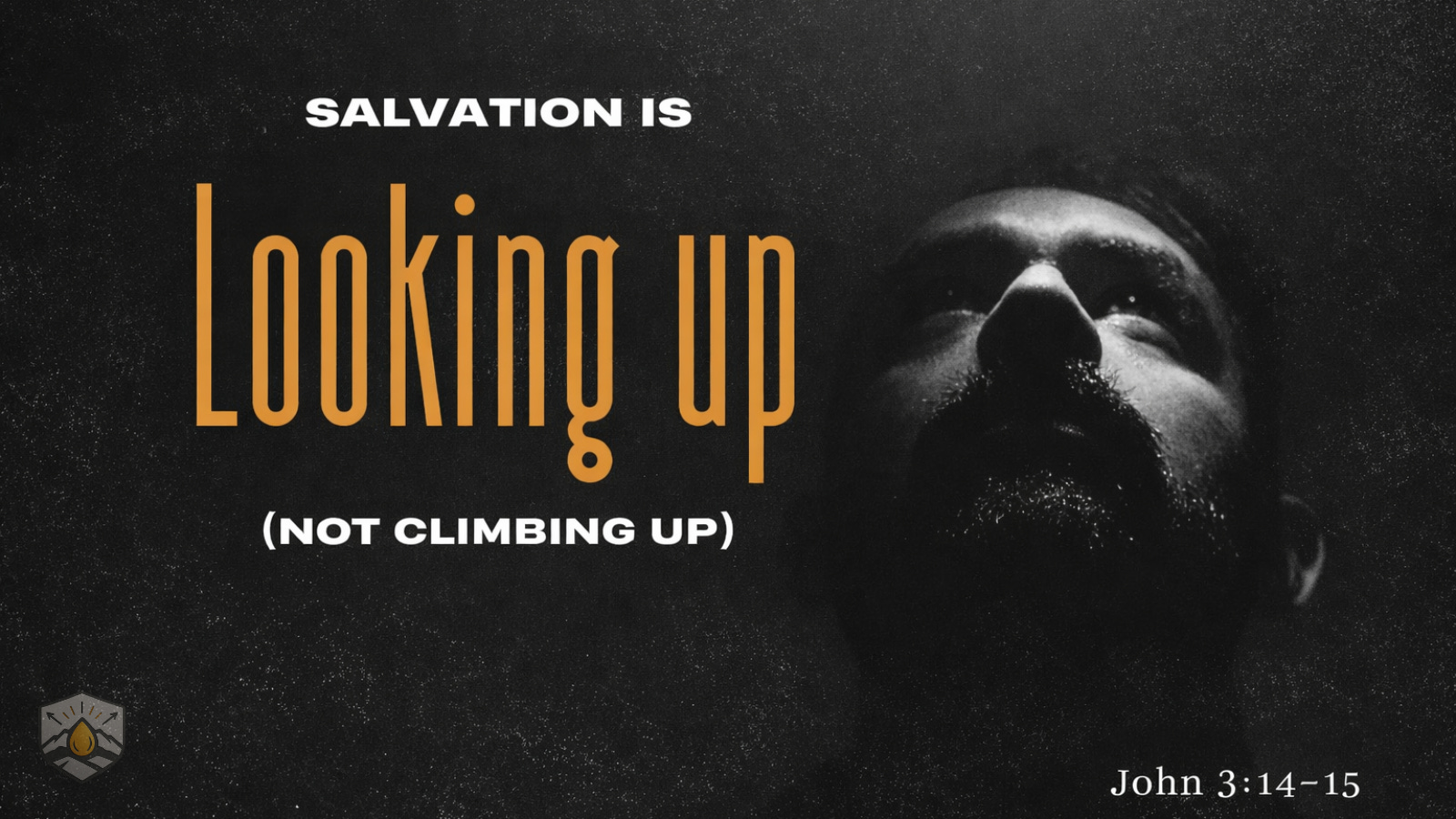
Salvation comes by looking up, not climbing up.
Pastor Tim Keller says the power of this image lies in its accessibility — anyone can look. Age, education, strength, or status do not matter. Even a blind man can crane his neck and look up.
A Closing Caution
The bronze serpent appears again in 2 Kings 18.
Over time, Israel began offering sacrifices to it and named it Nehushtan.
King Hezekiah destroyed it.
Even good gifts can become idols.
Never forget — God alone is worthy of our worship.
Mountain Mover — Look Up
Go back to Numbers 21 and examine why the Israelites ended up in the snake pit.
They had to go the long way.
They grew impatient (Numbers 21:4).
They grumbled and complained.
This is usually how we fall in the snake pit too.
The best way to avoid it?
Go the long way—on purpose.
Jesus said in the Sermon on the Mount:
“…If anyone forces you to go one mile, go with him two miles.” — Matthew 5:41
This wasn’t abstract advice. Under Roman occupation, Jews could be legally forced to carry a soldier’s pack for one mile. No more.
Jesus says: Do more than they expect.
That’s the Two-Miler mindset.
When you feel down, here are a few ways to live this out:
Carry a pack
Walk. Get outside. Fresh air matters. Add weight and add a friend. Rucking is simple, low-impact, and powerful.Carry someone else’s pack
Do something kind this week—especially for someone you don’t like. Buy that coworker a cup of coffee. Lighten someone else’s load.Carry the Word
Turn down the noise. Put God’s Word in your ears. Listen to worship music on your commute. Skip the podcast full of outrage, profanity, and conspiracy. Try the Suffer Up podcast — it’s all about the Two-Miler lifestyle.
Got another way to be a two-miler? Drop in the comments below.

—
Operation Mustard Seed
New article every Tuesday
—
The Suffer Up Podcast is available with a new episode each Monday on all platforms.
Important reminder that we must not idolize good things, even things God uses to save us—we worship Jesus alone! Thanks for writing this!
A great word with some solid themes that track all throughout Scripture. Love that we were on the same page today!